
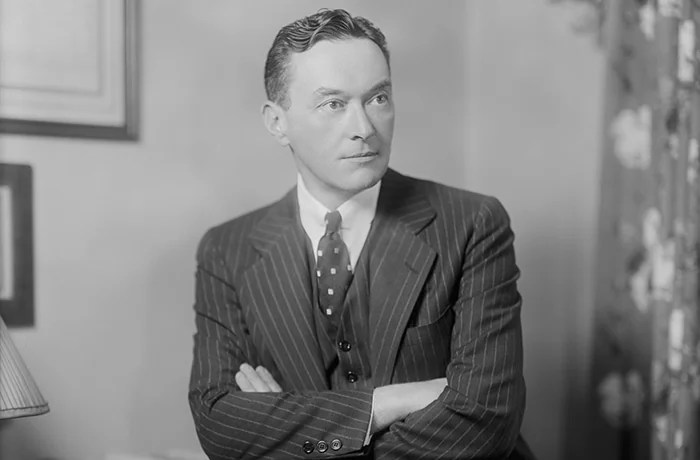
If writers should be judged by their words, then Tom Arnold-Foster’s comprehensive and engaging “intellectual biography” of the legendary journalist Walter Lippmann renders a complete, balanced, and mostly justified verdict.
Recommended Stories



A history fellow at the University of Oxford’s Rothermere American Institute, Arnold-Foster trains a critical eye on the varied and voluminous scribblings of Lippmann, whose middlebrow and highbrow writing alike had an immeasurable impact on 20th-century American politics, culture, economics, journalism, and even foreign policy. Lippmann, Arnold-Foster writes, “was remarkable for his breadth, versatility, and sheer durability.” He argues persuasively that Lippmann’s more radical edges were sanded down over time, as the journalist adopted the intellectual trappings of a mainstream American liberal.
Born on Manhattan’s Upper East Side to an assimilated German Jewish family in 1889, Lippmann scaled the academic ladder early and quickly. At Harvard University, he leapt into the fray, defending the suffragettes in a 1909 journal article for advertising themselves “at every opportunity, to let no day pass without reminding the country and its politicians of their demand.”
Four years later, at the ripe age of 24, he published his first book, titled A Preface to Politics, in which he argued that “the focus of politics is shifting from a mechanical to a human center” that “proposes to fit creeds and institutions to the wants of men.” He railed against political indifference, especially among his own generation, and also lambasted the hidebound American constitutional order, in particular, the Senate, as “pachydermic in its irresponsiveness.”

The following year, 1914, he published Drift and Mastery, in which he articulated a vigorous dedication to organized labor. “Without unions, industrial democracy is unthinkable,” he wrote. “Without democracy in industry … there is no such thing as democracy in America.” Yet he privately acknowledged that “I find less and less sympathy with revolutionists.”
Around that time, he founded the New Republic with Herbert Croly and Walter Weyl, a gambit that Arnold-Jones attributed to a careful strategy “to advance specific political outcomes through mainstream publications.” Most notably, and, in hindsight, embarrassingly, Lippmann’s New Republic became a mouthpiece for President Woodrow Wilson. “Protection of a healthy public opinion in this country will be of the first importance,” Lippmann told Wilson in 1917, and “all of us here [at the New Republic] are entirely at your disposal.” As the Great War raged, he served in the American Expeditionary Forces’ “Propaganda Subsection.”
After, and inspired by, the war, Lippmann set to work on Public Opinion, his magnum opus, which thoroughly studied the formation and deployment of popular views on public matters. Interest groups, property, and stereotypes played prominent roles and required careful shepherding by a benevolent elite. By today’s standards, his analysis seems elementary, but at the time, its systematic cataloguing was rather novel.
In the 1920s, ensconced as an editor and columnist at the New York World, he further developed his thinking about expertise and his skepticism about technocracy, noting that “aristocratic theorists work from the fallacy of supposing that a sufficiently excellent square peg will also fit a round hole” — perhaps Elon Musk’s Department of Government Efficiency experience reinforces this bit of wisdom. Lippmann strongly backed Al Smith’s 1928 presidential bid, in part because he thought Smith would defer appropriately to experts.
As the Great Depression struck, Lippmann sensed an “inchoate but profound sentiment that serious changes are needed.” Public opinion indeed vindicated this sense, as President Franklin Roosevelt swept into power and enacted unprecedented policies, bolstered by Lippmann’s rhetorical support. Congress, he argued, should “give the president, for a period say of a year, the widest and fullest powers possible under the most liberal interpretation of the Constitution.”

