
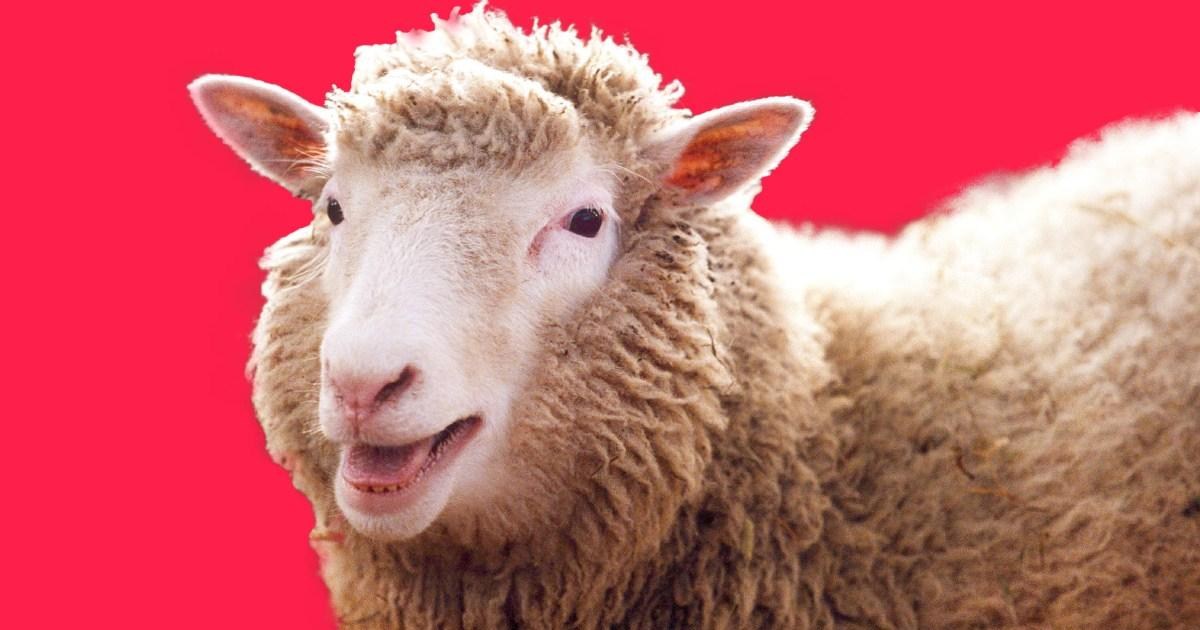
She may have started life in a petri dish and simply known as 6LL3, but thanks to her amazing contribution to science, Dolly the sheep went on to become one of the most famous farm animals in the world after being the first mammal ever to be cloned from adult DNA.
The little milennial lamb was born via a surrogate mother at Edinburgh University’s Roslin Institute on 5 July, 1996 – with huge implications on medicine, culture and the ethical issues around cloning.
The team, led by Professors Ian Wilmut and Keith Campbell, cloned Dolly from a single mammary gland cell from a Finn Dorset sheep, using a process where the nucleus from a donor egg is injected into a nucleus-free cell, creating an embryo genetically identical to the donor.
Named after Country legend Dolly Parton, who used to just as famous for her 40DD breasts as her singing career, their experiment proved that a clone could be made from adult somatic cells, not just from embryonic ones as previously believed.
However, Dolly was kept hidden for months, until the story was eventually broken by The Observer in February 1997 – and a media frenzy ensued.
‘By Monday the car park at the Roslin Institute was full of vans with dishes,’ embryologist William Ritchie tells Metro. ‘People had flown in from America in 24 hours to get the story.’
Working at Institue at the time, he had joined as a large-animal anesthetist before becoming an embryologist at the facility, where he still works.
‘I actually saw Dolly being born,’ William adds. ‘It’s very seldom thing to see as they’re often born at night.’
Unfazed by the press blizzard, Dolly took to standing at the front of the pen to greet visitors and developed a fondness for edible gifts – a habit William says made her a little plump.
‘She was a real madam – if you didn’t bring something to eat, she’d turn her back on you,’ he recalls. ‘If an animal ever deserved to be an icon, it was really Dolly.’
William’s wife, Marjorie, was an animal researcher and animal surgeon, and also a vital part of the pioneering team at the Insitute. When she developed multiple sclerosis, her husband would to take her down to the facility to see Dolly and the other animals on the site.
While the public was captivated, the reaction in the political and scientific community was more mixed – several renowned scientists at the time doubted that she’d really been cloned from an adult cell, a feat previously thought impossible.