
Would-be President Donald Trump assassin Cole Tomas Allen could be the poster child of a new wave of political violence in the United States. Through the ever more progressive media and academia, our society has created a generational cohort ready to kill fellow Americans to win political disputes.
Yes. Not only does a university education now correlate strongly with support for political violence, but graduate degrees make people even more bloodthirsty.
Recommended Stories


And, despite attempts to make universities less politically radical in the second Trump administration, there are signs that the leftist professors who have captured the faculty lounge are digging in.
COWARDS WISH DEATH ON ‘ALL TYRANTS’ AFTER WHITE HOUSE CORRESPONDENTS’ ASSOCIATION DINNER SHOOTING
As the Scots historian Niall Ferguson put it, there has been “no pendulum magically swinging back to sanity” in universities after the Great Awokening, the period during which American society was saturated with the propagandistic idea that the U.S. was an unjust, systemically racist society and, thus, in need of a systemwide overhaul.
Would-be Trump assassin Cole Tomas Allen, 31, was in college in the middle of the Awokening. He got his undergraduate degree in mechanical engineering from the California Institute of Technology, or Caltech, in 2017, and his master’s degree in computer science from California State University, Dominguez Hills, in 2025.
That means that everywhere he turned, whether academic papers or media reports, he imbibed deeply from a radicalizing potion that obviously had noxious consequences.
The Great Awokening began roughly around 2013, when Allen was 17 and not yet in college. That was the year when Black Lives Matter was born, and the Awokening became deeply entrenched the next year, when the Ferguson riots took place and BLM became a global network of organizations.
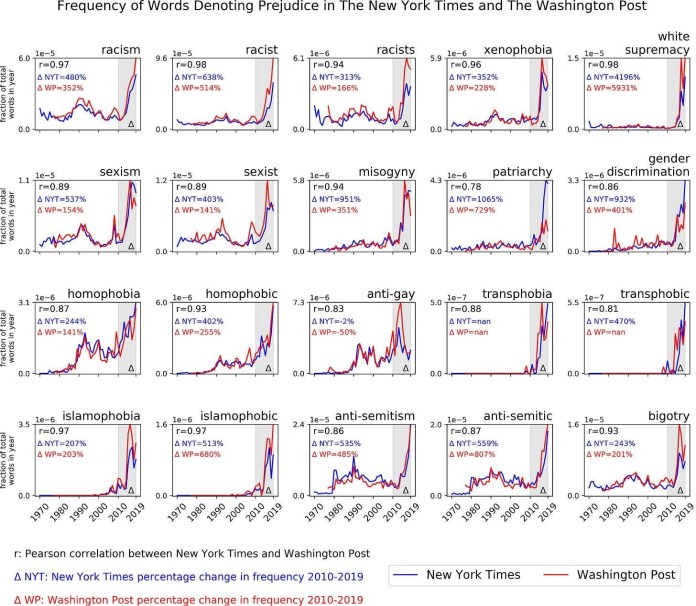
The Spanish-born academic David Rozado, a faculty fellow at the Heterodox Academy, has done superb work using data analysis to explain media bias and political polarization. His 2021 study, “Prevalence of Prejudice-Denoting Words in News Media Discourse,” lays out the role the media played in ensuring that the language of the Awokening entered the lexicon.
The use of the Awokening’s terms ballooned on the pages of the New York Times and the Washington Post between 2010 and 2019. The use of “white supremacy,” for example, grew 4,196% in the New York Times and 5,931% in the Washington Post. The numbers for “patriarchy” were 1,065% and 729%, respectively.
The rise in the use of the term “transphobia” was so high that it was impossible to calculate, but when Rozado looked at 47 news media outlets, he found that it rose 4,669%. Rozado also found similar rises in mentions in academic papers.
Rozado notes that his results “appear to indicate an acceleration of the trend after 2015.” That was the year Trump came down the escalator and announced his run for the White House. “Subsequent reactions to it may have exacerbated these trends,” he wrote. Trump became identified as the bulwark against social change.
The Great Awokening’s peak came in 2020 when the country was already on the edge because of the pandemic and the establishment’s draconian reaction to it. Then the George Floyd riots broke out nationwide and society truly teetered on fundamental transformation.
Trump began to realize what was happening halfway through 2020 and by late summer was making speeches and taking action to eliminate diversity, equity, and inclusion programs — the operating system of the Great Awokening — from the federal workforce and its contractors.
Former President Joe Biden, a politician not known during his long career for being sensitive to racial issues (quite the contrary), came into office a year later, fiercely instituting the principles of the Great Awokening throughout the government.
He signed his first executive order, “Advancing Racial Equity and Support for Underserved Communities Through the Federal Government” just hours after the inauguration, ordering all federal agencies to ferret out systemic inequalities, and then had multiple similar efforts throughout his snake-bitten four years in office.
The country fought back to reverse the Awokening, and in November 2024 reelected Trump with a mandate to do so. His second term has seen valiant attempts to turn back the tide.
But the prevalence of such radicalizing ideas in the academy and in newspapers read by the cognitive elite, such as the New York Times and the Washington Post, means that today those with higher degrees are much more accepting of the use of violence to win political and policy disputes.
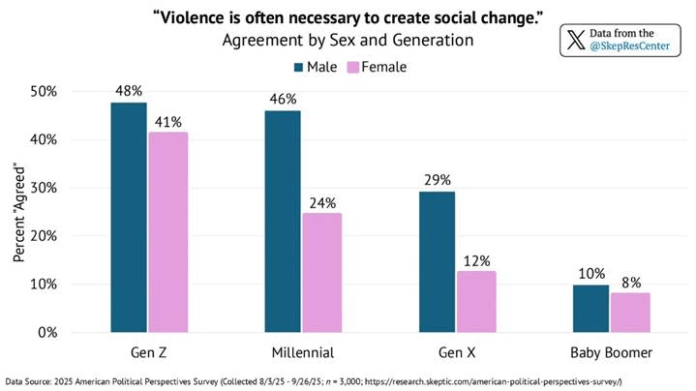
A 2025 survey by McCaffree, K., & Saide, A. for the Skeptic Research Center, “Support for Political Violence Among Americans,” makes clear that those with a bachelor’s degree and a graduate degree are much more likely to agree that violence is necessary to create social change.
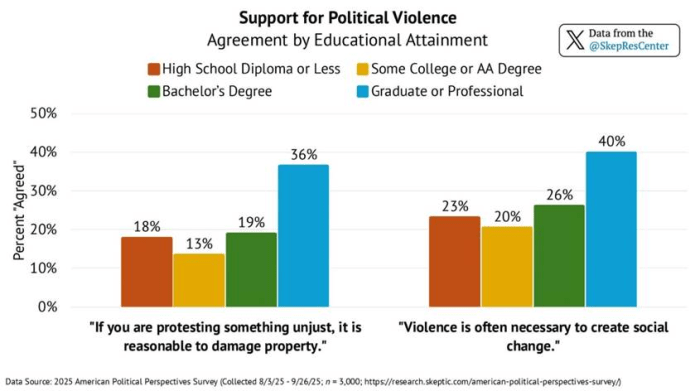
And unsurprisingly, the generations that went to university during the Great Awokening are the most willing to physically attack property or opponents. Allen, born in April 1996, is at the tail end of the millennial generation and the start of Gen Z, by far the two cohorts most willing to accept violence as the price of social change.
ENOUGH IS ENOUGH: THE LEFT MUST CEASE CALLS FOR POLITICAL VIOLENCE
Whatever this portends, it is clearly not good. Trump’s important battle to dewokify the commanding heights of culture — from the universities to the Smithsonian — continues apace, but it now must contend for the president’s attention with such pressing matters as China, Iran, Venezuela, and Cuba.
It’s right that we should defang our external enemies. But we must also do all we can to protect society here at home from those ready to create havoc in the name of social justice.