The last time the U.S. federal government had a balanced budget was in fiscal 2001, when it recorded a surplus of about $130 billion.
Recommended Stories



To a certain extent, that budget was a product of the conflict between Republicans in Congress and the recently departed Democratic President Bill Clinton. Republicans didn’t want a great deal more spending. Clinton didn’t want to cut taxes. One result of their clashes was a precariously balanced budget.
Fiscal years overlap with, but are different from, calendar years. This one ran from the beginning of October 2000 to the end of September 2001 — a fateful month, it turned out.
In the 25 years following that balanced budget, the federal government has not come particularly close to balancing its books, even once. Right now, it runs a structural deficit of approximately $2 trillion per year, every single year.
For fiscal 2025, for instance, the federal government took in $5.23 trillion in revenues and spent $7.01 trillion. That created a $1.78 trillion budget deficit for the year.
The U.S. government covers such gaps by borrowing money. Many corporations operate in a superficially similar manner. They finance short-term deficits by borrowing money. Firms service their debt and typically pay down the principal in surplus years.
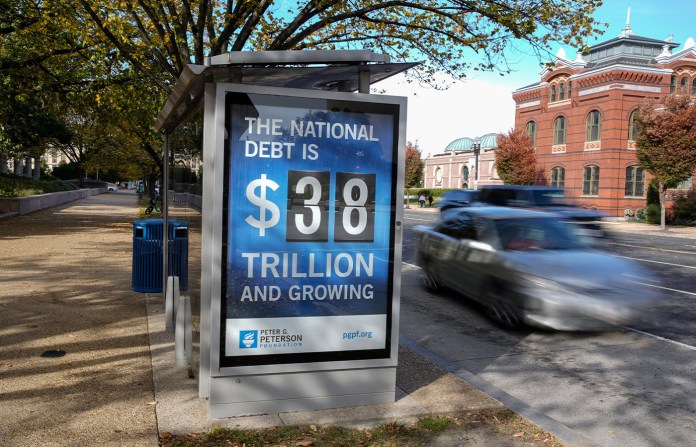
But the U.S. government hasn’t had any surplus years for going on 25 years. That means every year, more money gets heaped onto the debt. It stood at over $39.2 trillion at press time, according to a rolling debt clock provided by the Peter G. Peterson Foundation. That broke down to over $114,800 for every single American resident.
The sums required to service the national debt are not lunch money. Over $2.8 billion in interest is paid out every day. For the fiscal 2025, debt service cost taxpayers about $970 billion. That was close to one-seventh of all expenditures and slightly more than the federal government spent on the military that year.
The costly war on terror
The short-term driver of U.S. debt after fiscal 2001 was that 19 members of the al Qaeda terrorist network hijacked four planes and managed to fly two of them into the World Trade Center and one into the Pentagon. (The last crashed into a Pennsylvania field, brought down by a heroic passenger mutiny.) This kicked off what former President George W. Bush labeled the “Global war on terror.”
The two most expensive fronts in that war were the invasion of Iraq and the long occupation of Afghanistan. The Iraq invasion cost $3 trillion when long-term care for wounded soldiers is factored in, according to one popular estimate. Brown University’s Costs of War Project reckoned that even that estimate was “conservative in many respects.”
The Costs of War Project also found that the price tag for military actions the U.S. government had linked in some way to the war on terror had reached $5.8 trillion 20 years later. That past war spending continues to contribute significantly to the ever-growing national debt service costs.
The alternative to this war spending was almost certainly not zero expenditures. The Afghanistan action came in response to a real attack on U.S. citizens, institutions, and the larger economy. Even as staunch an anti-interventionist as former Rep. Ron Paul voted for the initial Authorized Use of Military Force resolution with Afghanistan in view.
The Texas Republican explained in a House floor speech that Congress, including him, for once, “recognized these attacks were not merely criminal acts but an ‘unusual and extraordinary threat to the national security.’”
Yet the Afghanistan action also dragged on for 20 years, as the hunt for Osama bin Laden mutated into territorial bribery and nation-building among the Pashtuns. It ended in a way that was both costly and unsatisfactory to much of the public.
Further, Iraq was a war of choice that went considerably worse and cost much more than those in the White House had predicted. Lawrence Lindsey was the White House’s chief economic adviser in 2002. Lindsey estimated an “upper bound,” worst-case cost of $100 to $200 million.
He suggested that overall, “war might be good for the economy.”
The Great Recession and COVID-19
In fiscal 2009, the U.S. government ran what up to that point was an extraordinary deficit of $1.4 trillion, or “about $960 billion more than the deficit incurred in 2008,” because “federal spending and receipts diverged dramatically,” as the Congressional Budget Office put it.
The federal government incurred significant short-term and long-term costs in response to a protracted “great” recession caused by the bursting of a U.S. housing bubble from about 2007 to 2009. The short-term costs included bailing out loan guarantors, Fannie Mae and Freddie Mac, to the tune of about $191 billion.
The federal bureaucracy is also greatly expanding safety-net outlays as millions of people found themselves unemployed and with little means to buy health insurance now that their employers were no longer picking up most of the check. Congress piled on top of that with a stimulus package.
We saw a similar pattern with the worldwide COVID-19 pandemic and government-mandated lockdowns in much of the country: increased social safety net spending, stimulus, bailouts. The Tax Policy Center estimates that this amounted to a $5.6 trillion contribution to the national debt. And of course, that new debt has to be serviced on an ongoing basis.
Structural deficits and your Social Security
Yet the story of the current national debt is not simply that a bunch of unforeseeable wars and crises happened.
“Over the past 10 years, from fiscal year 2015 through fiscal year 2025, total federal debt managed by Fiscal Service has increased from $18.1 trillion to $37.6 trillion,” the Government Accountability Office reported in January.
Those trend lines go up slightly with the spread of COVID-19, but not by much. The reasonably long-term trend has been in favor of ever greater spending, come what may. Efforts to challenge that growth have been largely marginalized and vilified, as when Elon Musk tried to use the Department of Government Efficiency to force through cuts early in the second Trump administration.
For the last 15 years, Social Security has been a driver of the debt. That’s because, starting in 2010, the government has spent more on Social Security than people are paying into the system. At the start, the amounts were not huge, but they are growing. In the current fiscal year, for instance, Social Security is expected to take in about $1.44 trillion and pay out $1.67 trillion.
“That cash shortfall of $230 billion, plus $20 billion in interest costs on Social Security’s accumulated past shortfalls, increases this year’s federal deficit by $250 billion,” explains Jessica Riedl, a scholar with the Brookings Institution.
A similar dynamic is at work with government healthcare funding programs, including Medicare and Medicaid. Similar to Social Security, they
are contributing to the yearly deficits. And like Social Security, they are projected to cost much more going forward.
No balance in sight
“Unsustainable” is a word that gets thrown around a lot when experts talk about entitlements. But entitlements are far from the only
problem with the U.S. government’s debt woes. In this century, we have seen a basic refusal of most leaders in Congress and the White House to own the trouble.
When the problem of increasing budget deficits was put to then-Vice President Dick Cheney, he reportedly brushed concerns aside by saying, “Reagan proved deficits don’t matter.”
That was par for the course for his administration. George W. Bush presided over significant growth in government spending and did not put the brakes on Congress by vetoing a single bill until well into his second term. He did propose reforming Social Security to 401(k)-ize it, but Congress wanted nothing to do with it. His final years in the White House were spent trying to salvage operations in Iraq and residing over stimulus and bailouts that ballooned the debt.
Barack Obama and, eventually, his Vice President Joe Biden were both elected to the White House with their own goals of expanding the federal government’s reach and footprint. They did so in their own ways, with Obamacare and a massive infrastructure bill. For them, a growing debt was not something to worry about.
President Donald Trump, in all three runs at the White House, declared Social Security and Medicare untouchable. He has been willing to cut some aspects of the federal government, particularly agency headcounts, and the country would almost certainly be spending even more money under different leadership.
TRUMP SAYS HIS STICKING POINT ON IRAN DEAL IS ENSURING REGIME CANNOT ‘BUY’ NUKE
Trump has occasionally paid lip service to the problem of the U.S.’s mounting debt. Yet he has left things off the table that might slow the accumulation, such as entitlement reform and reductions in military spending. His initiatives to address the problem, such as attempting to tariff most countries and one island populated entirely by penguins, have proved to be mostly beside the point.
The fiscal impact of Trump’s first term saw the debt grow by over $8 trillion, according to Treasury Department figures. The first fiscal year of his current term is expected to pile on an additional $1.9 trillion, to be paid for much, much later.
Jeremy Lott (@jeremylottdiary) is the author of several books, most recently The Three Feral Pigs and the Vegan Wolf.
