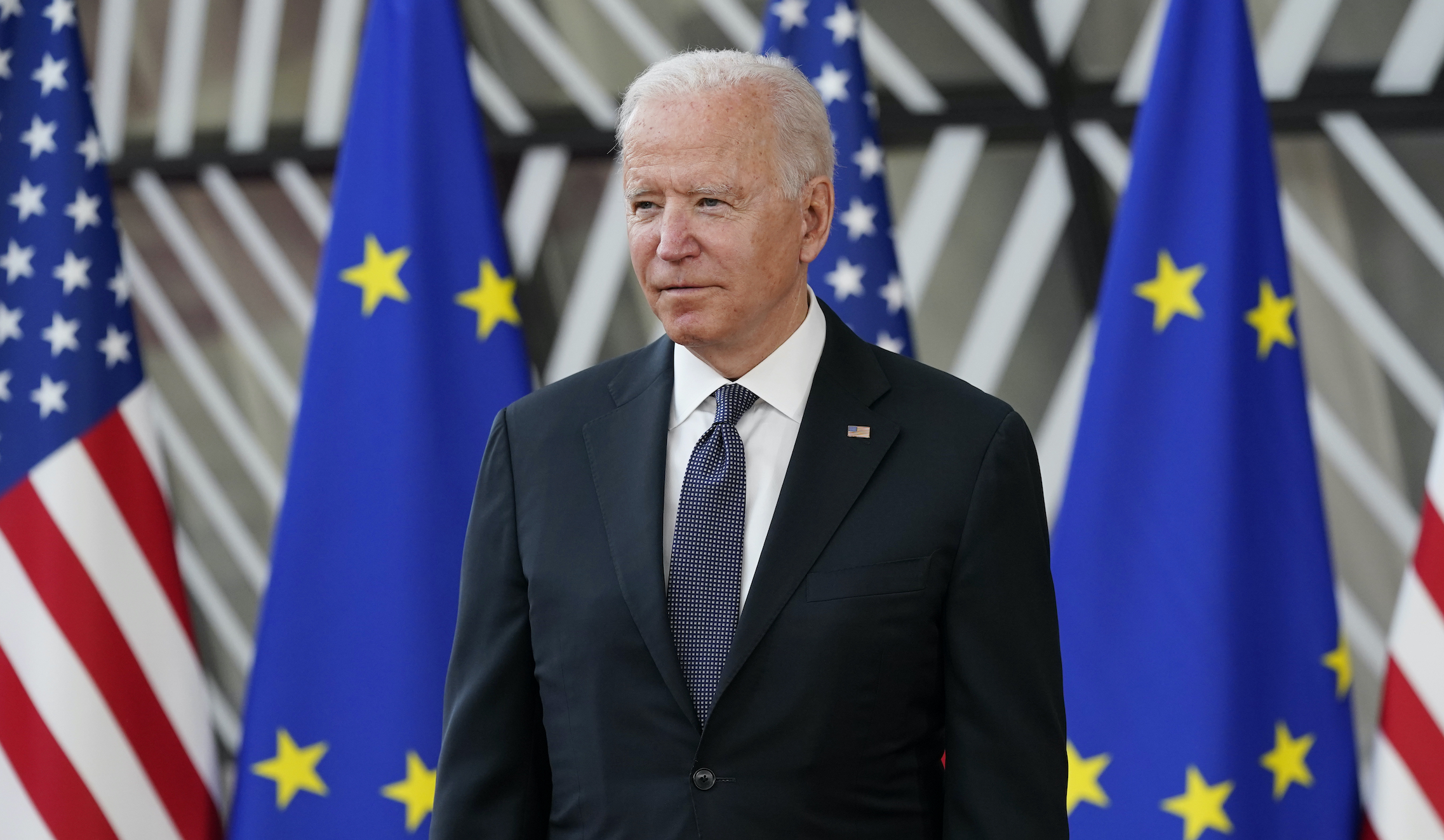
President Joe Biden showcased his folksy “Uncle Joe” public demeanor during his first trip abroad as commander in chief, forging new relationships with allies after four years of former President Donald Trump’s unconventional approach to diplomacy and foreign policy.
But Biden only slightly reeled in his “nice guy” persona after talks in the United Kingdom and Brussels as he prepared for his highly anticipated summit with Russian President Vladimir Putin on Wednesday, declining to repeat his belief that Putin is “a killer.”
Recommended Stories


Biden, a two-term vice president and longtime Senate Foreign Relations Committee chairman, needs to balance the perception of him as an “everyday guy,” according to Bob Inglis, a former South Carolina Republican congressman who served as a Foreign Affairs Committee member.
That perception was on display Tuesday as Biden addressed EU leaders in front of reporters, saying he had spoken enough and his mother would have told him to “hush up.”
Inglis’ criticism is Biden softened his tone toward Putin after agreeing only three months ago that the former KGB agent is “a killer.”
“I wish he would just go ahead and call him a killer because that’s what he is and stick with that,” he told the Washington Examiner. “[Russia] is an organized crime syndicate that happens to have nuclear weapons.”
Biden should have described Putin as “an alleged killer” so he would have felt comfortable telling that to the Russian’s face without looking like he had backed down, Inglis suggested.
“I think Joe Biden’s wishing he chose his words more carefully to start with,” he said.
G-7 and NATO leaders seemed receptive to Biden’s down-home manner, except for British Prime Minister Boris Johnson. Johnson could not hide his amusement when the president interjected to remind Johnson to introduce South African President Cyril Ramaphosa.
“And the president of South Africa, as I said earlier on,” Johnson said.
“Oh, you did,” Biden responded.
“Yes, I certainly did,” Johnson replied.
For historian David Greenberg, sometimes a president must be tough and adversarial, but this is “the time for reconciliation.”
“I don’t think there’s any question that Biden’s diplomatic style is more effective than Trump’s,” the Rutgers University history and journalism professor said. “Trump managed to alienate most of our allies — needlessly.”
For Inglis, presidents face extra pressure to judiciously exercise power as the leader of a superpower, so partners respect them.
“If you exercise it capriciously, people fear you. And they’ll figure a way to get you back when you have your defenses down,” he agreed with Greenberg.
“You can act like J.R. Ewing or Donald Trump, and you can make people really hate you,” Inglis added. “In which case, there are no amount of F-16s that can protect us if people are gunning for us.”
Charles Kupchan, a Council of Foreign Relations senior fellow who staffed Biden as a National Security Council aide during Barack Obama’s administration, believed the president patched up frayed transatlantic tensions and fostered democratic solidarity during the first stops of his international tour. But Kupchan’s interpretation of the G-7 and NATO communique is that Biden had “to give a bit of ground on China,” a possible area of future friction where “Uncle Joe” may be required to be combative.
“When he needs to be, he’s tough,” Kupchan said of Biden.
Kupchan predicted Biden’s conversations with Putin on Wednesday would be uncomfortable. The president would likely broach them with eyes wide open and with low expectations as he gauges his adversary’s interest in collaboration.
“There is not a warm and fuzzy bond between the two leaders,” he said. “At the same time, they would not be sitting down with each other if they were not hoping to have a constructive dialogue and, at a minimum, to make the U.S.-Russia relationship less troubled at a time when one could argue it has hit rock bottom.”
“On the other hand, if you speak truthfully, but in a civil way, perhaps you can find areas of agreement on climate change, on the pandemic, the Arctic, on trade,” he went on.
Putin will not concede Ukrainian territory, release opposition leader Alexei Navalny from jail, or promise not to hack into another U.S. computer, according to Kupchan. And Biden’s team had sidestepped unnecessary drama by not holding a joint press conference.
“I would tell Biden, ‘Listen, Putin has been playing the bad boy now, for a long time. Do I think this is a turning point? Probably not. But let’s test it,'” he said.
CLICK HERE TO READ MORE FROM THE WASHINGTON EXAMINER
Biden refused to utter the word “killer” during a post-NATO gathering press event, though he reiterated that Putin himself had admitted there were “things that he would do or did do.”
“I don’t think it matters a whole lot in terms of this next meeting we’re about to have,” he said of the “killer” assessment, referring to Putin as “bright,” “tough,” and “a worthy adversary.”
