
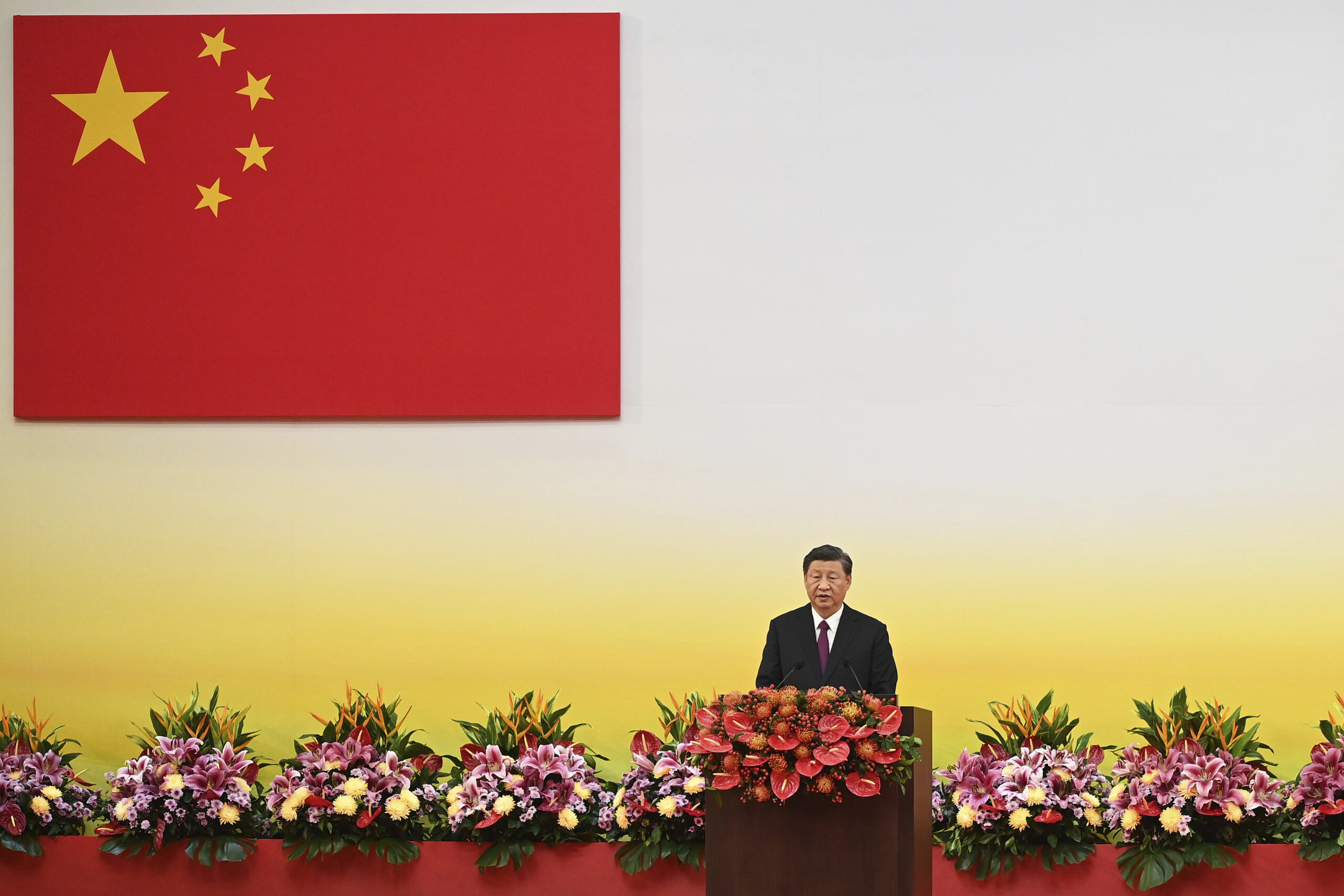
China has threatened to initiate an “extremely serious” standoff with the U.S. military over House Speaker Nancy Pelosi’s (D-CA) prospective trip to Taiwan.
Recommended Stories


“The U.S. … must not arrange for Pelosi to visit the Taiwan region,” Chinese Defense Ministry spokesman Senior Col. Tan Kefei said Tuesday. “Should the U.S. side insist on doing otherwise, the Chinese military will never sit idl[y] by and will certainly take strong and resolute measures to thwart any interference by external forces and secessionist attempts for ‘Taiwan independence’ and firmly defend China’s national sovereignty and territorial integrity.
That statement is among the latest in a series of public warnings against the trip, which Chinese Communist officials characterize as a violation of their claim to sovereignty over the island democracy. The ostentatious truculence presents Pelosi and U.S. officials with an apparent choice between a crisis that Pentagon officials want to avoid and public acquiescence to Beijing’s threats — an unpalatable menu of options, notwithstanding the fact that Pelosi’s travel plan “hasn’t been announced yet,” as U.S. officials have emphasized.
“And frankly, that kind of rhetoric is unnecessary and uncalled for,” John Kirby, the White House National Security Council coordinator for strategic communications, said Tuesday in response to the Chinese Defense Ministry’s remonstrance. “And there’s no trip to speak to, and rhetoric of that kind only escalates tensions … so we find that unhelpful and, certainly, not in the least necessary given the situation.”
Unhelpful is perhaps the goal. Chinese Communist officials have denounced U.S. political and military support for Taiwan as a violation of their “One China Principle,” but the Biden administration, like Donald Trump’s before him, has signaled political support for Taipei while racing to fortify the island’s military against the possibility that the Chinese Communist regime would try to subjugate Taiwan. That dynamic has given rise to back-channel signals to American experts, delivered by a former Chinese official, that Beijing is itching for a confrontation on the scale of the third Taiwan Strait crisis in 1996.
“There’s a view in Beijing that it might be necessary to have a crisis to demonstrate China’s seriousness on Taiwan issues to the United States,” the American Enterprise Institute’s Zack Cooper told the Washington Examiner.
Then-Speaker Newt Gingrich visited Taiwan the year after a show of U.S. naval power ended the 1996 crisis. China may take the current controversy as an opportunity to attempt to reverse that precedent and set new limits on U.S. government engagement with Taiwanese officials.
“Given the misstep by the White House in openly signaling disagreements within the administration about the speaker’s planned visit, it gives the impression that the U.S. could be deterred into preventing officials, even ones from the legislative branch, from traveling to Taiwan. This would be a dangerous precedent to set,” Global Taiwan Institute Executive Director Russell Hsiao told the Washington Examiner.
“My sense is that this is not as much about Speaker Pelosi’s visit itself but more an overall hardening of Beijing’s strategy in the use of sticks against all forms of engagements with Taiwan that it considers a violation of its ‘One China Principle,’” he said.
Kirby, the White House official, acknowledged that the Pentagon could have a role in guaranteeing Pelosi’s security if she proceeds with the trip.
“The speaker is in the line of succession, and so when she travels overseas, her security is important to U.S. national security,” he said. “The security footprint that goes along with her, or is established in the location, changes based on [not] just the geographic location but certainly the environment … but wherever she goes, there are security requirements that have to be taken into account … and as appropriate, the Department of Defense gets involved in helping meet those requirements.”
Kirby was at pains, however, to emphasize that Pelosi might not go. “I want to stress: The speaker has not announced any travel, so we’re speaking hypothetically about a trip that, as far as we know, hasn’t been decided,” he said.
CLICK HERE TO READ MORE FROM THE WASHINGTON EXAMINER
President Joe Biden’s team might prefer that it would remain hypothetical. “I think their view is still that it’s not a good idea,” Cooper said. “I just think the administration’s concerns are — it’s not that she can’t go [ever] — it’s that they genuinely think this is not great timing. … They genuinely feel that we’re walking into a very serious crisis.”
