
The Trump administration aggressively framed New York’s Penn Station overhaul as a signature example of President Donald Trump using federal intervention to revive stalled infrastructure projects, arguing Wednesday that the long-delayed redevelopment effort only gained momentum after Washington stepped in and took control from local transit agencies.
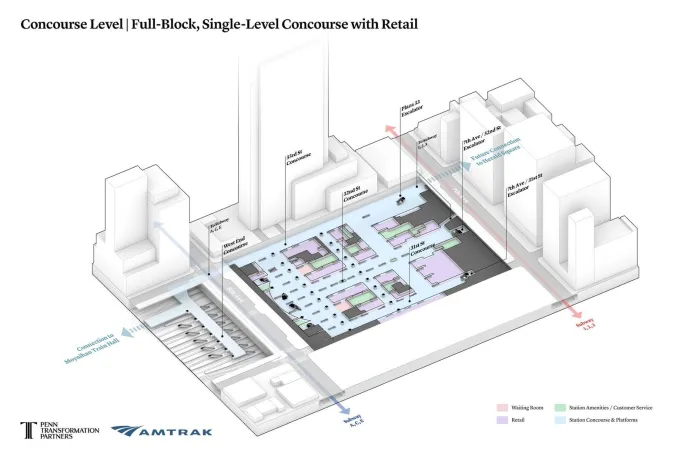
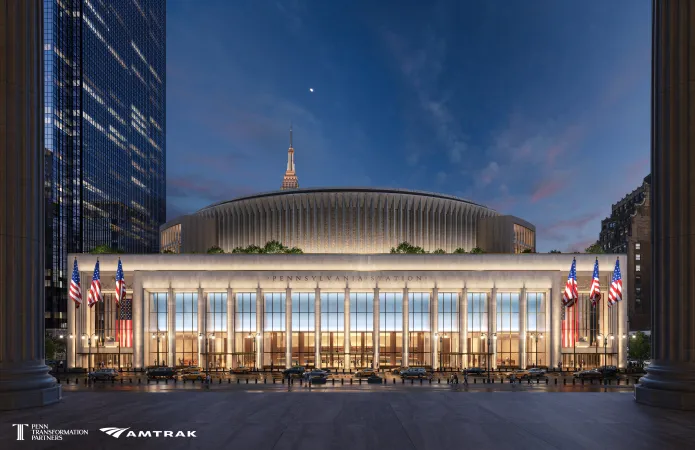
The renewed messaging push came days after Amtrak and Penn Transformation Partners unveiled dramatic new renderings of the proposed station overhaul, which would transform the aging transit hub into a sprawling single-level concourse featuring expanded public space, soaring ceilings, new retail areas, and a monumental Eighth Avenue entrance designed to flood the station with natural light.
Recommended Stories



Administration officials are now explicitly tying the project to Trump’s broader push to reshape public infrastructure around aesthetics, centralized accountability, and what officials describe as “beautiful” civic architecture.
“Regardless of a state’s politics, President Trump and [Transportation] Secretary [Sean] Duffy are investing in big, beautiful infrastructure projects like New York’s Penn Station and Dulles International Airport because they believe America’s infrastructure is a reflection of the American Spirit,” a Transportation Department spokesperson said in a statement provided to the Washington Examiner.
The Trump administration took control of the Penn Station redevelopment project from New York’s Metropolitan Transportation Authority last year and handed oversight to Amtrak, which owns the station. Officials argue the move was necessary after years of stalled plans, fragmented leadership, and bureaucratic dysfunction.
“The game changer here is the president’s involvement and the administration’s involvement,” Andy Byford, the British transit executive overseeing the project for Amtrak, told the Washington Examiner on Wednesday. “Multiple attempts through decades have been made to transform Penn, to rebuild Penn, and they failed.”
Byford, who previously helped modernize London’s Underground system, said the administration imposed what he described as “single-point accountability” by putting Amtrak fully in charge of the redevelopment effort rather than relying on what he called “management by committee.”
“The president said, ‘Amtrak, let’s have absolute single-point accountability, one entity leading,’” Byford said. “You can’t have management by committee.”
Byford also suggested Trump’s personal connection to New York helped elevate the project inside the administration.
“The president’s a New Yorker, he’s a developer,” Byford said. “He doesn’t want just a reconstructed station. He wants to see this transformed.”
Officials have increasingly framed the overhaul as part of Trump’s broader effort to leave a visible mark on some of the country’s most recognizable civic and transportation spaces, particularly in New York, where the president built his real estate brand and long maintained deep personal and business ties.
Penn Station, the nation’s busiest rail hub, serves roughly 650,000 travelers daily but has long faced criticism from commuters who describe it as overcrowded, confusing, and visually uninviting.
“At the moment, you’ve got this dingy maze of dark, low ceilings, corridors,” Byford said. “It’s confusing. The signage isn’t great.”
Under the proposal, officials say the station would see roughly a 165% increase in public space, a 33% increase in elevators and escalators, and significant platform widening through the removal of roughly 100 structural columns.
The newly released renderings depict a dramatically brighter station centered on a vast open concourse with a glowing coffered ceiling and oversized central clock. Another rendering shows a monumental Eighth Avenue entrance framed by towering stone columns and American flags, evoking the grandeur of the original Penn Station, demolished in the 1960s.
Plans for the redesigned station also include a presidential seal featuring Trump’s name, according to project materials released this week.
Byford repeatedly described the proposal as a “transformation” rather than a reconstruction.
“New York should have the best station in the world,” he said. “This will be America’s world-class station.”
The Penn Station push is also part of a broader Trump administration effort to tie infrastructure policy to aesthetics, civic symbolism, and federal control over major public spaces.
Earlier this year, Trump signed executive orders titled “Making the District of Columbia Safe and Beautiful” and “Making Federal Architecture Beautiful Again,” while Duffy later launched what the department described as a first-of-its-kind Beautifying Transportation Infrastructure Council focused on redesigning highways, bridges, and transit hubs.
“What happened to our country’s proud tradition of building great, big, beautiful things?” Duffy said when announcing the council. “It’s time the design for America’s latest infrastructure projects reflects our nation’s strength, pride, and promise.”
The Transportation Department has also taken a more direct role in other major transit facilities. After reclaiming management authority over Washington’s Union Station, Duffy argued the station had “fallen into disrepair” and said federal intervention would help restore the terminal as a “world-class transit hub.”
Officials estimate the Penn Station overhaul could ultimately cost between $7 billion and $8 billion, though Amtrak executives acknowledged the financing plan has not yet been finalized.
Byford said the administration has already committed roughly $243 million toward planning and development work and hopes to break ground by the end of 2027.
“We’ve already started down that road,” Byford said when asked about financing. “There’d be a very, very big federal contribution.”
Still, major questions remain surrounding how the project will ultimately be funded and coordinated among the many agencies involved.
Gov. Kathy Hochul (D-NY) previously said the state would withdraw the $1 billion it had committed toward the project after the Trump administration transferred oversight from the MTA to Amtrak.
But Byford argued the combination of federal oversight, private-sector involvement, and direct presidential attention gives the project momentum that previous plans lacked.
DOT AND AMTRAK PICK ‘MASTER DEVELOPER’ TO LEAD $8 BILLION PENN STATION RENOVATION
“I don’t get involved in the politics,” Byford said. “I’m here to build a station.”
“This should be a world-class station,” he added. “It will be.”
